Last month a client brought me a single shoe-box with eight tapes in it. Her first question was not about quality or turnaround. It was “what is this going to cost me?” It is the question most people ask first, so here is the honest answer: VHS to digital cost depends on how many tapes you have, what condition they are in, and who does the work. This guide breaks down the price across every option, so you can decide what makes sense for your collection.
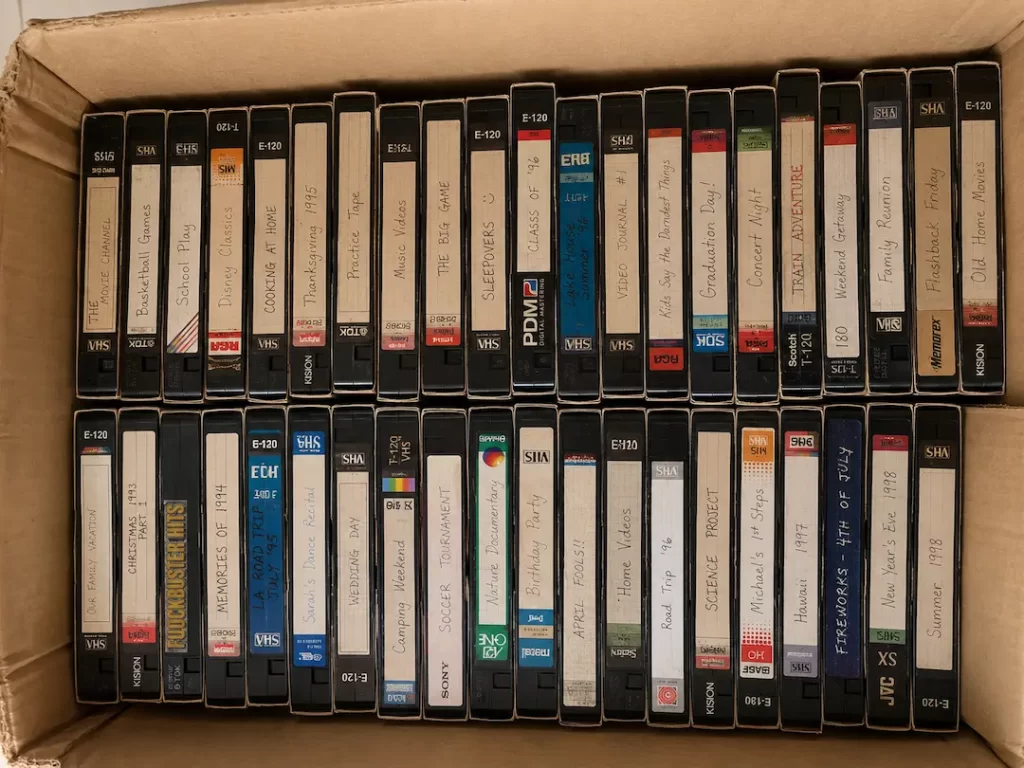
A box of labeled family VHS tapes the kind sitting in millions of attics right now
What Drives VHS to Digital Cost
Five things determine the price of any conversion project.
The number of tapes matters most. Nearly every service prices per tape, and most offer volume discounts once you pass ten or twenty.
Tape length is second. A tape is captured in real time, so a two hour tape takes two hours of machine time. Most professional services charge a flat rate per tape up to about two hours; longer tapes may carry a small surcharge, and some retail chains charge per 30 minutes of footage instead, which can quadruple the price of a full tape.
Condition is the wildcard. Tapes with mold, sticky shed syndrome, or broken shells need attention before they can be played. Mechanical repair typically adds $10 to $30 per tape, and professional mold cleaning is a separate service at $35 to $85 per tape. A tape that squeals or screeches when played or rewound likely needs treatment first; my post on VHS tape degradation covers the warning signs.
Format matters more than people expect, and the reason is equipment. VHS, VHS-C, Hi8, Video8, and MiniDV were common, so working decks still exist and those formats cost the same to convert. Rare formats like Betamax cost more because the machines that play them are scarce, expensive, and wear out.
Finally, what you get back. Digital files delivered by download are usually the base price. A USB drive, DVD copies, label transcription, or editing add to it.
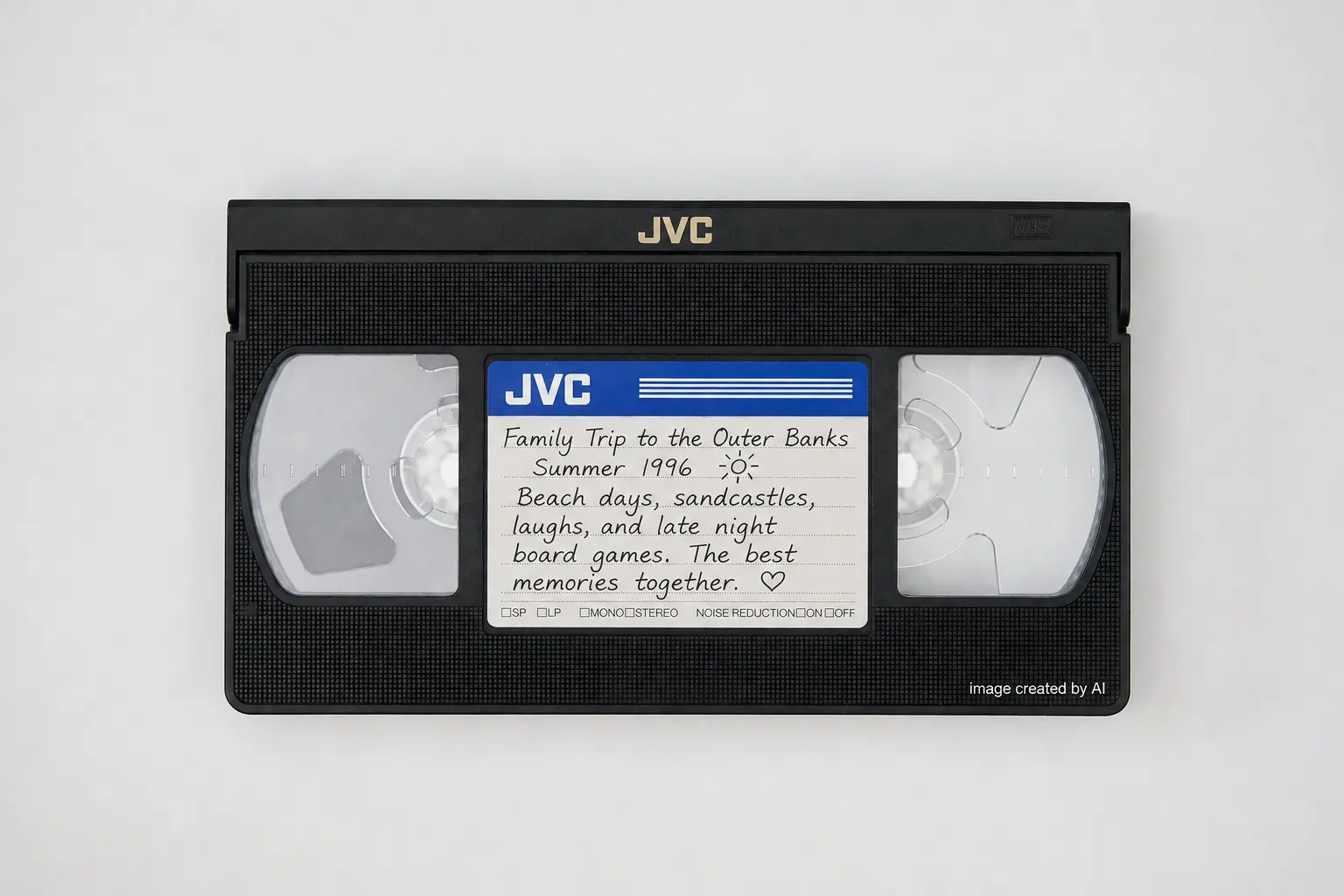
The handwritten label is often the only clue to what a tape holds
What the Options Actually Cost
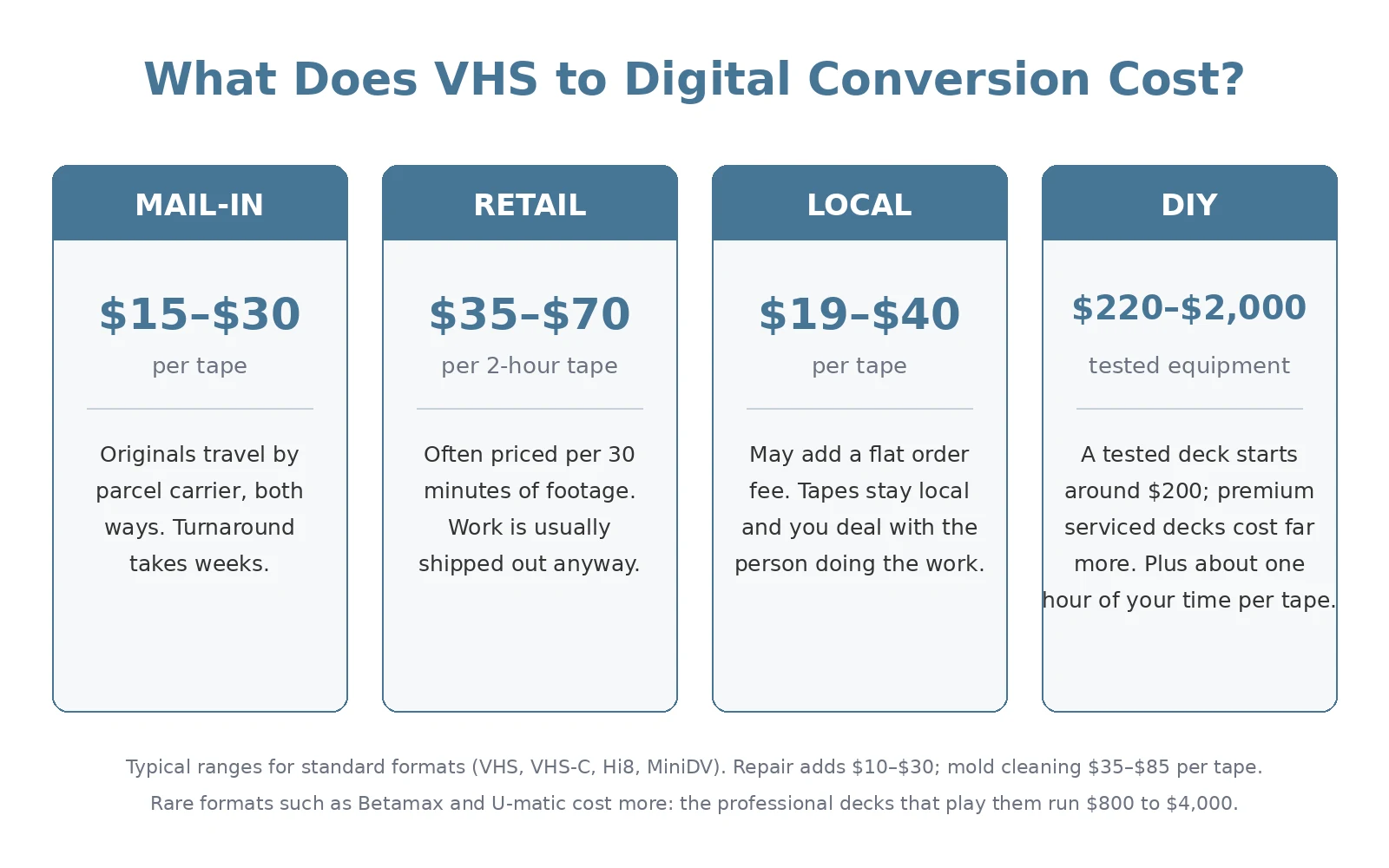
Mail-in and independent services run roughly $15 to $30 per tape depending on volume. The trade: your irreplaceable originals travel by parcel carrier, twice, and turnaround is measured in weeks. Some keep prices low by sending the work overseas for processing, which adds transit time and means your originals spend weeks out of your hands.
Retail drop-off at pharmacy and big-box chains often prices per 30 minutes of footage rather than per tape. A full two hour tape can reach $35 to $70, which surprises people who expected a per-tape rate. The work is usually shipped out to large processors anyway.
Regional and local services around New York typically run $19 to $40 per tape, and many add a flat service fee of around $50 per order. That flat fee matters more than it looks: on a five tape project it adds $10 per tape. The advantage is that your tapes stay local, you deal with the person doing the work, and you can ask about condition and quality before committing.
Doing it yourself costs more than most people expect. A tested working VCR starts around $200 used, a premium deck that has been cleaned and serviced runs $1,800 to $2,000, and a USB capture device adds $20 to $150. Then your time, at roughly one hour per tape plus setup, a learning curve, and file handling. Unless you already own a working deck, the equipment never pays for itself on a small collection, and on a large one the hours become the real cost.
The Cost Nobody Puts on the Price List
Every year of waiting raises the real price. Magnetic tape degrades whether it is played or not, and VHS tapes from the 1980s are already past their expected lifespan. Each play of an aging tape wears it further, so watching the originals one last time before converting has a cost of its own. Footage that has degraded past a certain point cannot be recovered at any price. The cheapest conversion is the one done before the tape needs rescue work.
Working VCRs are also disappearing, which pushes DIY costs up each year and leaves fewer technicians and parts around to repair damaged tapes.
This is what magnetic tape degradation looks like on playback Once a tape reaches this stage recovery is difficult or impossible
How to Keep the Cost Down
Sort before you convert. Most collections contain tapes nobody needs: recorded television, duplicates, blanks. Converting only what matters can cut a project in half. A local service can often check a mystery tape for you before you commit, something a mail-in box cannot do.
Compare what the price includes, not just the per-tape number. USB delivery, label transcription, and HD enhancement are often separate line items. Two services quoting $20 per tape can end up $150 apart on the same box of tapes.
Ask how blank or unrecoverable tapes are handled. Good services do not charge full price for them.
Frequently Asked Questions
How much does it cost to convert one VHS tape to digital?
Between $15 and $40 at most services. Mail-in is cheapest per tape but adds shipping risk, retail can cost more than it appears, and local services bundle the handling into the rate. Damaged tapes cost more; volume brings the per-tape price down.
Is it cheaper to convert VHS tapes myself?
Rarely. Buying equipment for a small collection never pays: $220 of gear to convert three tapes costs more than any service. A large collection spreads the equipment cost out, but then the hours become the price, since thirty tapes means thirty-plus hours of your attention. DIY makes sense when you already own a working deck, or when you enjoy the project for its own sake.
Why do retail stores seem cheap but end up expensive?
Many charge per 30 minutes of footage rather than per tape. A full two hour tape is four billing units, not one.
Why do Betamax and other rare formats cost more?
Equipment scarcity. The decks that play rare formats are expensive, hard to find, and wear out with use, and that cost flows into the conversion price.
What format should I ask for?
MP4 files, delivered by download or on a USB drive. They play on any phone, computer, or TV, they are easy to back up and share, and an entire collection fits in one place. A DVD holds only a few hours per disc, so a tape collection becomes a stack of discs, and DVD players are going the way of VCRs.
Do damaged or moldy tapes cost more?
Yes. Mechanical repair typically adds $10 to $30 per tape, and mold cleaning runs $35 to $85 per tape as a separate service. The longer a damaged tape sits, the lower the odds repair will succeed.
If you are in Brooklyn or the New York City area, I convert VHS and other tape formats personally. Nothing is shipped, and your originals never leave the city. I will help you work out what your collection needs, and what it does not.
Written by Henk van den Berg, Certified Photo Manager based in Brooklyn. I help families digitize and organize a lifetime of photos, slides, and home videos, then set up a system they can keep using on their own.